
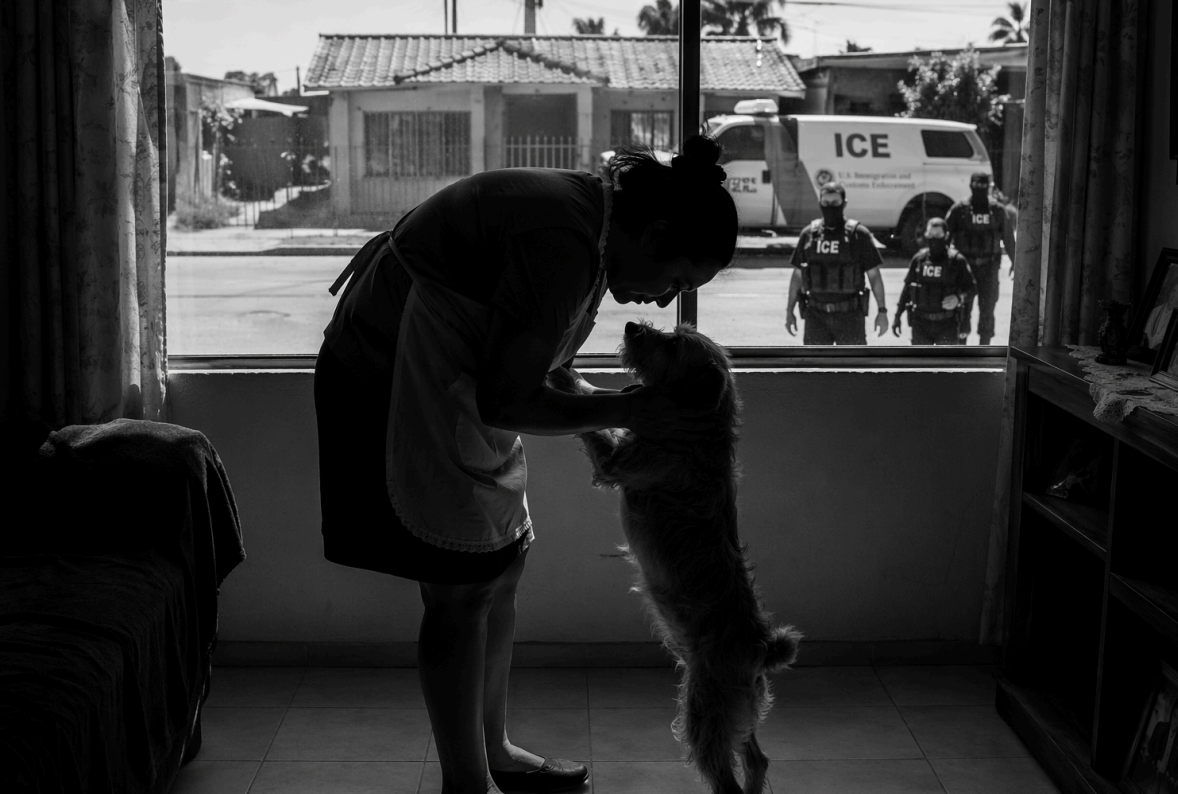
Image created by author using DALL·E through ChatGPT
During the second Trump (Trump-2) administration, U.S. Immigration and Customs Enforcement (ICE) has deported more than 605,000 individuals and, with intimidation, has convinced approximately two million more to “self-deport" under an administration program euphemistically incorporating that term. In addition, at any time, ICE holds tens of thousands, not yet deported, in arrest or detention facilities. Many of these had pets in the U.S. when ICE took enforcement action. This article addresses the consequences of ICE actions on those pets.
ICE’s enforcement is unprecedented in numerous respects.
To appreciate the impact on pets of ICE’s enforcement actions, it’s critical to understand that, not only are their numbers unprecedented, but so are their nature, breadth and speed. Collectively, these characteristics mean ICE poses a far greater risk to immigrants’ pets than ever before. Where to start?
Among others, the enforcement actions have included metro surges (such as in Minneapolis, Los Angeles, Chicago, New York); racial and xenophobic profiling; fearmongering; gaslighting; drive-through arrests; expedited removals; deployment of poorly trained military and federal police; expanded use of poorly trained state and local police as “proxy” immigration officers; forced entries into homes via administrative warrants not issued by true judges; mistaken detention of U.S. residents; and excessive force during arrests.
They have also included detention quotas; denial of legal counsel; pausing of asylum applications; pressure to increase deportations on immigration judges (who, contrary to assumption, are not independent judges, but are part of the administration); detentions and deportations of DACA recipients; deportations to countries where deportees have no ties; mandatory detention expansions; threats to end birthright citizenship; efforts to end deportation protections for hundreds of thousands of Syrians and Haitians; and ICE and attorneys from the Justice Department lying to courts. This list could, and does, go on.
What happens to pets when ICE acts?
ICE does not take responsibility for pets.
Despite Trump’s "One Big Beautiful Bill Act" allocating an unprecedented $170 billion for immigration enforcement and the more than doubling of ICE personnel to 22 thousand, the Department of Homeland Security (DHS), which oversees ICE, has acknowledged that, when ICE takes enforcement actions against a person, it does not take possession of known pets, regardless of circumstances, even to take them to a shelter. Moreover, DHS declined to answer questions seeking clarification of that policy.
However, in an effort to defuse the public’s concerns about the consequences of ICE actions for pets, an ICE spokesperson issued this carefully scripted, misleading statement to a contributing writer for Forbes who was investigating those consequences:
ICE always asks arrested aliens a series of questions to determine if they have any responsibilities such as animals in their care. If so, ICE makes contact with state, local or municipal authorities or agencies as appropriate.
Despite an extensive search through ICE policies, procedures, training material or other information, I’ve found nothing suggesting that ICE routinely—much less “always”—asks about pets or notifies authorities or agencies about them. Moreover, in response to my request for such documents and information, and for an explanation of how ICE documents alleged contacts with state, local, or municipal authorities or agencies, it has provided nothing. Nevertheless, ICE agents may occasionally take these actions.
The ICE statements quoted above are also contradicted by reported examples of what has actually happened to pets when ICE suddenly takes their guardians into custody, including, for example, when ICE agents failed to take possession of Lucero, a dog, after arresting her trucker guardian near a gas station, and when they allowed another dog to run off after detaining its walker guardian.
Finally, it’s difficult to imagine ICE taking the predicament of pets seriously when it treats immigrants so poorly and when it’s been, until very recently, overseen by former DHS Secretary Kristi Noem, who, in her book, infamously touted shooting her pet dog and goat as evidence of her qualifications for making tough, but appropriate, decisions.
Some pets stay with families in the U.S.
Some pets are fortunate to live with a family in the U.S. who can continue to support them even after a family member has been the subject of ICE actions.
Some pets are not discovered for long periods.
A Washington Post article reported that two Great Pyrenees were discovered still living in an empty house for an extended period after an immigrant left a house in the aftermath of ICE raids. The dogs had water, but no food, and weighed less than half their breed’s normal weight.
Some pets die from harsh weather.
Sadly, some pets die before being discovered by neighbors or shelters. The The New York Times reported that after an immigrant family left their house due to ICE actions, a dog who had recently had four puppies stayed outside the house. Two of the puppies froze to death; the other two protectively burrowed under the house.
Most pets probably end up in shelters.
Many, if not most, of these pets end up in shelters, which are already overcrowded and underfunded. Some are surrendered to shelters by their guardians. For example, after living in the U.S. for 25 years, the guardian of Lolita and Bruno and their six puppies surrendered all of them to a shelter before his deportation. Faced with the ICE raids in Los Angeles, the guardians of Draco, a German Shepherd, decided to self-deport. When their airline declined to allow Draco on board, they surrendered him to a local shelter.
While shelters have made herculean efforts to re-home pets, some have been euthanized for lack of space, financial constraints, and adoption challenges. Chuco, a three-year-old pit bull, who eventually made it to a shelter after his guardian was arrested during a raid at a Home Depot, may suffer that fate.
Some pets join their voluntarily deported families.
Subject to resolving the issues addressed below, some voluntarily deported families can take their pets back to their former homes.
What can be done to minimize ICE’s collateral damage to pets?
Many steps can be taken to minimize this damage. Here are a few.
ICE can obey laws.
If ICE obeys laws, fewer people will be illegally subject to its enforcement, so fewer pets will be left behind.
ICE can exclusively focus on violent criminals.
ICE and the administration routinely justify their unprecedented actions by broadly and repeatedly painting all those arrested as violent criminals—the “worst of the worst”. In fact, only about 5% of people detained by ICE have convictions for violent crimes. A recent poll shows 65% of Americans believe the administration has gone too far in its enforcement actions. If, consistent with ICE and the administration’s messaging, ICE focused only on violent criminals, many fewer pets would be impacted.
ICE can change its policies relating to the pets of arrested persons.
Instead of misleading the public about its pet-related policies, ICE could actually change them so it better protects pets from becoming victims of ICE enforcement. It could also provide funds to shelters for pets who are such victims. Americans would certainly support those moves.
Pet guardians at risk of ICE arrest can follow precautionary steps.
Several organizations have prepared lists of precautionary steps pet guardians at risk of ICE arrest should take to protect their pets. See, for example, HumanePro, World Animal Protection, The Bond Between, Evermore Pet Food, Vicaverge, and Los Angeles County Department of Animal Care and Control. These steps include identifying a backup caregiver, updating your pet's vaccinations, assembling an emergency pet care kit, getting your pet microchipped and creating plans for different scenarios.
Shelters can take steps to help protect pets.
Shelters are already at the forefront of efforts to help pets impacted by ICE actions. HumanePro has prepared an outline titled, “How animal shelters and rescues can support pet owners at risk of detention or deportation.”
We can support shelters.
We can support local shelters by donating money and food and by adopting pets.
Disturbingly, some pet guardians feel forced to self-deport for their own safety and that of their pets.
Given ICE’s current move-fast-break-lives tactics, some pet guardians at risk can reasonably choose to self-deport. While far from ideal and not freely chosen, that action gives them some potential control over their pet’s future—not to mention their own—including the possibility of transporting their pet to the country they emigrate to. The administration does not, per se, pay for that transportation or allow pets on flights, but some guardians can, where economically possible, arrange and pay that expense on their own, or from the $2,600 that our government pays immigrants to self-deport. For pets to be allowed into another country, guardians must navigate a combination of U.S. export laws, airline policies, and the import laws of their destination country. Those can be costly and time-consuming, often longer than the roughly 21-day period when self-deportation occurs.
Even forcibly deported pet guardians can attempt to reunite with their pets.
Although challenging, a forcibly deported person can sometimes successfully bring their pet to the country where they’re deported, provided someone in the U.S. has possession of the pet and is willing to assist with the process. However, they face the same government and financial barriers mentioned in the previous subsection.
Conclusion
Mahatma Gandhi famously said: “The greatness of a nation and its moral progress can be judged by the way its animals are treated.” Even as our country is currently failing many other tests of human morality, immigrants’ pets violate no immigration policies and don’t even reach the level of afterthought for ICE and the current administration. None of this has to be the case.
Frank Brown, member UU of Arlington, Va