The Strategic Power of Humor for Animal Advocacy
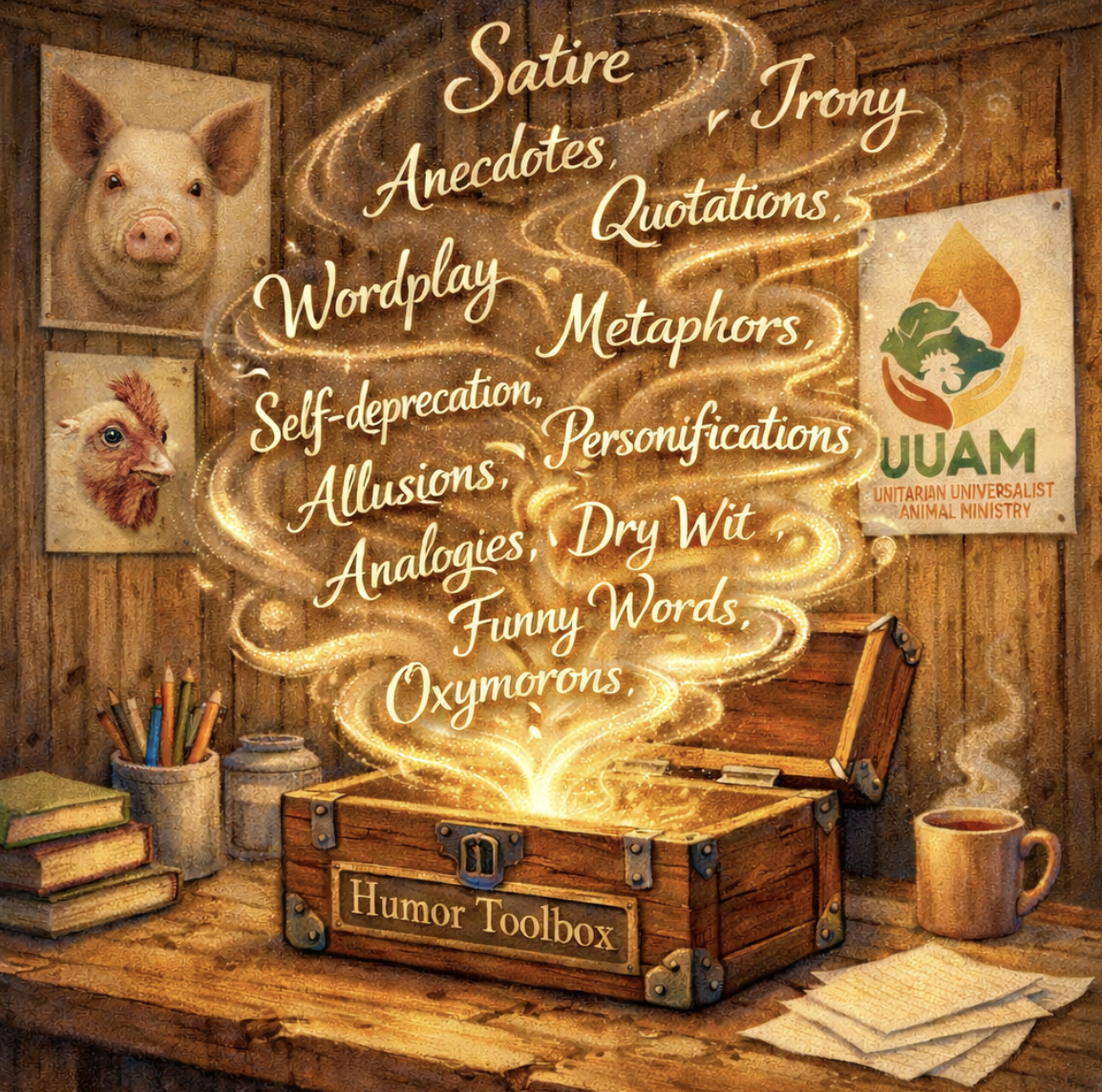
Image by author using ChatGPT
“Humor is a way of saying something serious.” — T. S. Eliot
Chances are you, like me, appreciate humor, especially in these challenging times. I can’t think of a time in my life when we have needed it more. In recent years, scholars have extensively studied the strategic power of humor in business and broader social-justice settings, but far less in animal advocacy. Moreover, social-justice humor has prioritized professional comedians or consultants over the independent efforts of advocates. These gaps have left relatively unexplored the strategic power of humor as a day-to-day communication tool for animal advocates like us—whether in our independent presentations, community settings, and interpersonal outreach—and as a source of personal resilience. This article examines that subject, drawing on insights from the business, social-justice, and nascent animal-advocacy humor arenas, and occasionally (on condition of anonymity), my own experience.
How can humor aid animal advocates?
Humor helps advocates.
Advocating for animals can at times take an emotional toll and stir feelings of hopelessness and helplessness. Humor enables advocates to sustain resilience, hope, and optimism by lifting our spirits, loosening the grip of negative emotions, reframing our perspective, rekindling our energy, and bonding us with others. As one social activist observed, “We laugh so that we do not cry, and then we get to work.”
Humor provides a gateway into tough topics.
Because animal welfare issues often provoke discomfort, many instinctively turn away. Humor can keep them engaged long enough to take in what they learn. Matt Abrahams, a strategic communication instructor at Stanford Business School, creatively captured this dynamic as an “aha behind the haha.” Richard Pryor put it more simply: “People will listen to you if you make them laugh.”
Humor can disarm defensiveness.
Many become defensive when they feel judged about their consumption of animal products or their positions on other animal issues. According to distraction theory, humor occupies cognitive resources that would otherwise be used to formulate counter-arguments, thereby reducing perceived threat and increasing receptivity to the message. As Mary Hirsch observed, humor is “a rubber sword—it allows you to make a point without drawing blood.”
Humor makes advocates relatable and their cause inviting.
Animal advocates are often stereotyped as angry, humorless, preachy, and self-righteous. Humor helps dispel that trope, revealing warmth and authenticity and making the cause feel less like a burden and more like an invitation.
Humor strengthens advocacy.
Humor makes animal advocates more effective across several interconnected dimensions: audiences tend to view advocates who use humor as higher‑status, more credible, and more trustworthy; they also find them more likable, personable, and authentic. Humor captures attention, makes messages more enjoyable, and therefore increases their memorability and shareability. In addition, humor signals confidence, invites creativity, and helps advocates remain flexible in their communication, allowing them to adapt their tone, connect with diverse audiences, and navigate difficult topics with greater ease.
What types of humor can animal advocates use?
Humor offers a remarkably wide and flexible toolbox. Different forms work for different personalities, audiences, settings, and goals. The point is not to become a stand-up comic or to tell a joke or two, but to find forms of humor, subtle or otherwise, that feel natural and that help the message land.
Relationship-building humor
Relationship-building humor lowers defenses and makes advocates more likable and trustworthy. It includes gentle anecdotes, playful observations about everyday life, and poking fun at oneself. A good example was written by John Millspaugh, UUAM’s Executive Director, in the caption of a photo he used in one of his columns. The picture shows him kneeling in a barn next to a rescued pig:
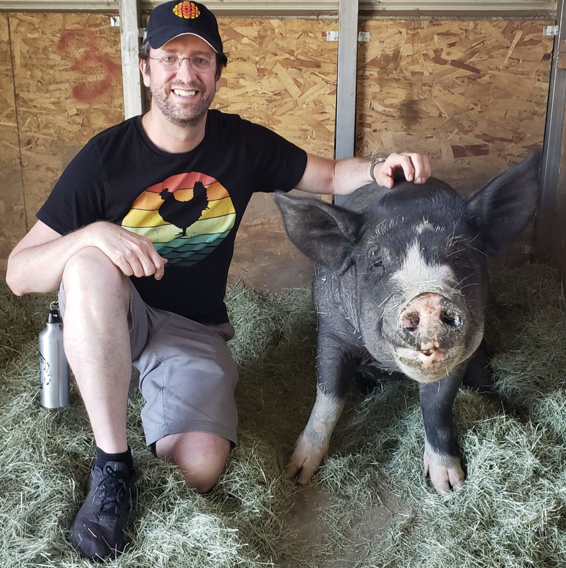
John (here with Rue, who was found on the side of the highway, likely after escaping a transport truck, who now lives her best life at Farm Animal Refuge. I’m the one wearing the hat.)
Insight-revealing humor
Insight-revealing humor helps audiences see familiar practices in a new light. Irony, incongruity, exaggeration, understatement, euphemisms, and oxymorons can expose moral contradictions, such as loving some animals while eating others, without sounding accusatory or preachy. Examples of this type of humor, which soften messages about the mistreatment of animals, include animated talking animals to highlight factory farming conditions and cartoons that give pets human voices to “complain” about their care. I also like The Far Side comics by Gary Larson that masterfully use anthropomorphism and perspective-shifting to make humans empathize with farmed animals and often give them an imagined, short-lived, but satisfying and amusing upper hand.
Satirical humor
Satirical humor, including parody, spoof, and caricature, can be especially effective when it targets factory farm animal welfare practices and the widespread humanewashing of animal products. Even consumers of animal products generally don’t want to be lied to about welfare standards. Thus, humanewashing provides animal advocates an additional, backdoor avenue to share information with consumers about factory farm practices, do so aggressively and in an industry-mocking manner, show the disparity between claims and reality, and team up with consumers on a common concern.
Language-based humor
Language-based humor works especially well in articles, social media, slide presentations, and campaign slogans. Wordplay, puns, neologisms, playful alliteration, portmanteaus, inventive hyphenation, funny words, jargon and slang, and other verbal surprises drive its effect.
Across humor types
Humorous quotations and literary devices, such as metaphor, simile, analogy, allusion, personification, anthropomorphism, portmanteau, synecdoche, metonymy, and asides, can operate effectively in any of these forms.
What are the General Rules of Humor for Animal Advocates?
Be Yourself: You aren’t trying to be a professional comedian. Your greatest asset is your own authentic personality.
Determine the Goal: Before using humor, ask yourself what you want to achieve. Is it to build a bridge, or to highlight a contradiction?
Read the Room: Always evaluate the appropriateness of humor based on the setting and the audience’s current emotional state.
Never Trivialize the Issues: Skewer the absurdity of the system, never the reality of the suffering.
Punch Up: Target powerful systems, dominant norms, and the architects of exploitation.
Don’t Punch Down: Avoid mocking or shaming individuals, especially those who are still learning. This preserves empathy and keeps the door open for change.
Be Generous with Laughter: Adopt a mindset of levity. Be open to the humor that arises from your audience and, as Naomi Bagdonas, co-author of Humor, Seriously. Why Humor is a Secret Weapon in Business and Life, suggests, "be more generous with your laughter."
Conclusion
Animal advocacy is serious work. Humor is a serious way to do it more effectively while making ourselves feel better.
Frank Brown, member UU of Arlington, Va.
Partial List of Sources and Additional Reading
A Comedian and an Activist Walk into a Bar: The Serious Role of Comedy in Social Justice
“Comedy for Social Change” (review of The Revolution Will Be Hilarious, Comedy for Social Change and Civil Power)
“Humor in Social Movements: A Novel Take on Environmentalism”
“Revolutionizing Activism: Using Humor When Things Are Dire”
“Make ‘Em Laugh: How Humor Can Be the Secret Weapon in Your Communication”
“Using humor in communication helps scientists connect, build trust”
“Exclusive interview with animal activist Dr. Jane Goodall”
“Comedy as a vegan outreach tool”
“Editorial: humour and environmental education”
“Center for Media and Social Impact”
“Comedy and Democracy: The Role of Humor in Social Justice”
“Activism and the power of humour”