Four Leaps Backward: Trump Endangers the Endangered Species Act and Its Protected Habitats
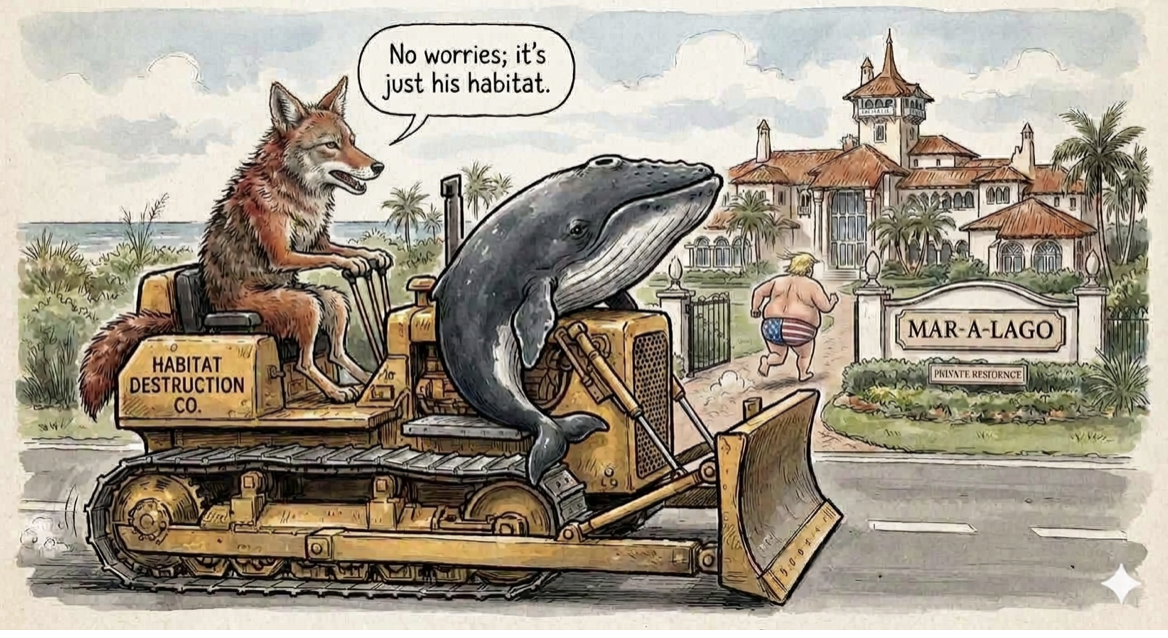
Image by author Frank Brown using Nano Banana 2 through Google AI
The Endangered Species Act (ESA) of 1973, adopted with overwhelming, near-unanimous bipartisan support and credited with saving 99% of listed species from extinction, is widely considered one of the most powerful and successful endangered species laws in the world. Yet that record of success is now under attack. In an unprecedented, coordinated assault on the ESA in just the last few months, the Trump administration (“Administration”) took four leaps backward, particularly on habitat protection, where its actions reflect an it’s-just-habitat philosophy, as satirized in the image above. Unless blocked, these measures will dramatically erode the ESA's protections, favoring instead oil and gas production, mining, logging, ranching, land development and other commercial interests. This article unpacks those actions, the Administration’s stated rationale for them and the legal actions challenging them.
Narrowing Prohibited Killing and Injury
For the last 51 years, an ESA regulation, known as the harm rule, generally outlawed not only acts that directly killed or injured endangered and many threatened wildlife species, but, as a matter of biological reality, also acts that caused significant habitat modification or degradation, which, in turn, actually killed or injured them by significantly impairing their essential behavioral patterns, such as breeding, feeding or sheltering.
In July, to the peril of these species, including the red wolf bulldozer driver in the image above, the Administration eliminated the habitat protection, thereby enabling death or injury by significant habitat modification or degradation. Paradoxically, it charged ahead even as its agencies responsible for ESA enforcement, the U.S Fish and Wildlife Service, and NOAA Fisheries explicitly recognize on their websites that habitat loss is the primary threat to most ESA species.
Exempting Gulf Drilling from ESA
In March 2026, the Administration convened the Endangered Species Committee, better known as the "God Squad" because of its power to bless actions even if they may cause a protected species’ extinction. In a perfunctory vote, the committee, composed entirely of Trump officials and appointees—and, of course, no endangered or threatened species—unanimously granted the first-ever exemption permitting the federal Gulf of Mexico oil and gas program, and therefore federally approved private oil and gas companies, to drill and conduct other operations without complying with key ESA requirements. This decision jeopardizes the habitat of ESA-protected species, such as the Rice's whale, seen hood-riding in the image above.
Although the Administration’s primary stated rationale for the exemption was an alleged national security threat from impacts on global oil and gas markets posed by the Administration’s Iran war, the exemption was not tied to the war’s duration and could continue for years. This suggests the stated rationale was at least partially pretextual and revealed a broader desire to expand Gulf drilling. Even if the explanation was sincere, the Rice’s whale and other protected species may become yet more victims of the Administration’s war.
Weakening Critical Habitat Protections
In July 2026, the Administration issued a new regulation that makes it easier for Administration officials to exclude areas from ESA-designated “critical habitat” by giving greater weight to economic, national security and other impacts of those designations. Critical habitats are specific geographic areas considered essential to the conservation of a listed species and that therefore may require special management or protection. The Administration is expected to employ this new regulation to aggressively limit critical habitat.
Ending a Longstanding Safety Net for Threatened Species
Also in July 2026, the Administration repealed the ESA's longstanding "blanket rule" for threatened species, which are those species not yet endangered but on a path toward extinction unless conditions improve. Over decades, newly listed threatened animals generally received the same protections against being killed, harmed, captured or otherwise "taken" as endangered animals unless the U.S. Fish and Wildlife Service adopted a species-specific rule providing different protections.
Under the new regulation, newly listed threatened species will no longer automatically receive those protections. Instead, the Service will decide on a species-by-species basis what protections, if any, they will receive. Critics warn that this change leaves many threatened species more vulnerable during the often lengthy period before species-specific protections are adopted and could invite weaker protections for some species than under the blanket rule.
Framing the Rollbacks as Restoring Balance
In addition to the stated national security rationale for the Gulf exemption, the Administration defends these actions as necessary to restore “balance” to the ESA and prevent it from imposing what the Administration contends are excessive burdens on energy production, economic development and private property rights.
Challenging the Rollbacks
The Humane World for Animals, Sierra Club and National Wildlife Federation, along with a broad coalition of other conservation and animal-protection groups and federally recognized tribes, are challenging or plan to challenge aspects of the Administration’s rollbacks. Additional parties, including states, may join those challenges. Collectively, the plaintiffs seek to set aside the Administration’s actions as unlawful. The outcome of these court cases, which may take years to finally resolve but may result in preliminary injunctions against the Administration’s actions, could shape the ESA’s future for years to come, inviting us all to consider our role in protecting the ESA and our animal kin it safeguards.
Frank Brown, UU of Arlington, Va. member
ADDITIONAL READING
“Trump rule says habitat destruction does not harm endangered species”
“Trump, Ending Decades of Protection, Opens Wild Habitats to Drilling and Mining”
“Trump administration allows killing of species threatened with extinction”
“U.S. panel votes to exempt Gulf of Mexico drilling from Endangered Species Act”
“Trump Administration Scales Back Endangered Species Protections—Again”
“Attacking the Endangered Species Act – and What You Can Do”
“Stop Trump’s “God Squad” from driving species to extinction”
“CleanLaw — The ‘God Squad’s’ Unprecedented National Security Exemption”