
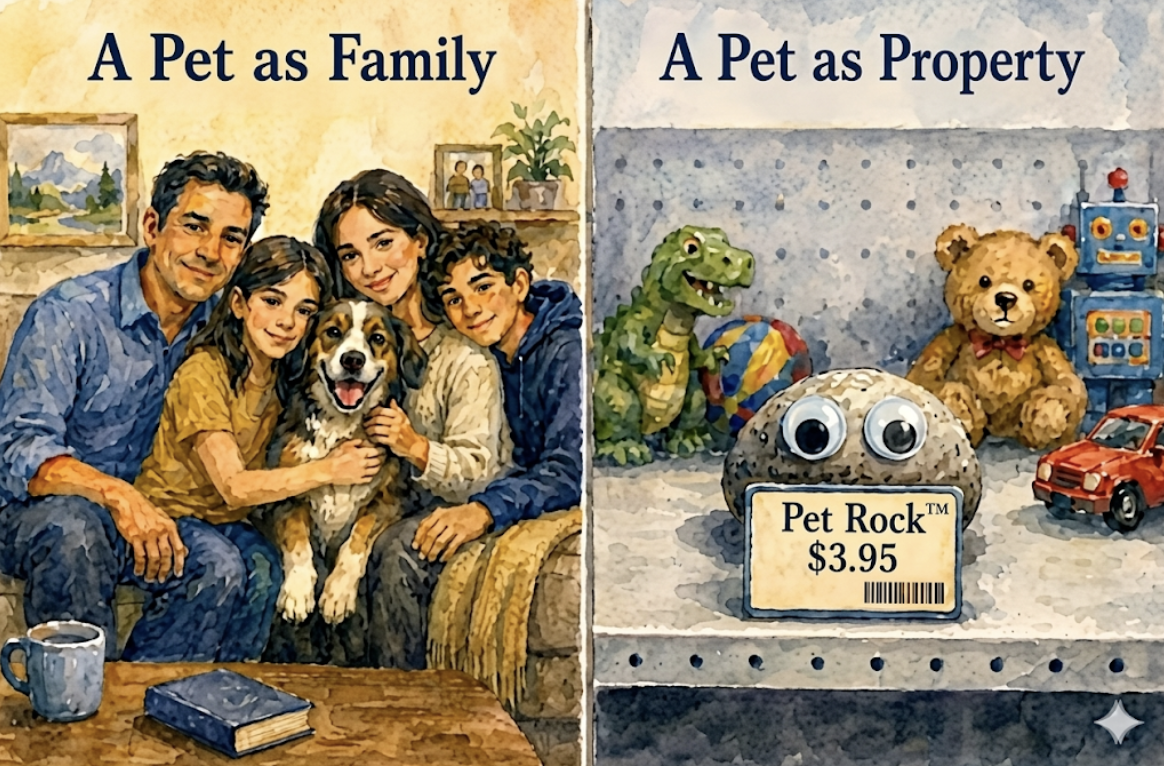
Image created by author using GEMINI
In a kind of reverse alchemy, American law generally transforms our family pets into the fictional status of “property.” A pet becomes, legally speaking, more Pet Rock™ than family member. This property classification profoundly restricts the legal rights of pets and their guardians when pets are intentionally or negligently injured or killed by an unrelated party, such as a driver, neighbor, animal control officer, vet, boarding facility or pet groomer. This article discusses those restrictions. I use “guardian” here to refer only to pet guardians, not human ones.
CAN PETS SUE?
Property can’t sue. Just as the law doesn’t allow other property (your toaster, lava lamp, disco ball, or even Pet Rock™) to file a lawsuit, it denies real pets the independent right or, in legal terms, “standing” to sue.
CAN GUARDIANS SUE?
Because the law treats pets as property, it allows guardians to sue in civil court for injuries to, or the death of, their pets. If the injury or death results in a criminal prosecution, say for animal cruelty, the court sentence may include restitution, a requirement that the offender reimburse the guardian for “economic damages” (discussed below).
WHAT DAMAGES CAN GUARDIANS GENERALLY RECOVER?
The rules for awarding pet damages vary by state and get a bit weedy. Some of the resources linked below detail those variations. However, guardians can typically recover the following “economic damages” for the wrongful injury or death of their pet.
The Reduction in the Pet’s Value
If a pet is killed, the guardian can recover the pet's “value” just before the pet dies. When a pet is injured but not killed, the measure of damage is the difference between his or her value before and after the injury. In almost all states, value means “market value”: the amount someone would pay for the pet in an open market. In determining that value, a court can weigh the pet’s purchase price, condition, age, breed, pedigree, training, breeding value, working/service capacity, and other relevant factors.
Because many pets have minimal market value, this recovery is ordinarily modest. My wife and I paid $9 for Sam and $16 for Barney, our first two Atlanta Humane Society mutts. We didn’t tell them what we paid, but Sam, a classic top-dog personality, would have been appalled by his de minimis market cost, while Barney, with his last-and-least-if-at-all self-esteem, would have been flattered by his. They were equally valued by us.
Vet Bills
Customarily, pet guardians can also recover reasonable vet expenses associated with the pet’s injury or death, although their reasonableness is often successfully challenged, particularly when the expenses exceed the market value of a pet. In some states, recoverable vet expenses cannot exceed the pet’s market value.
WHAT DAMAGES ARE RECOVERABLE FOR HUMAN FAMILY MEMBERS BUT NOT FOR GUARDIANS?
Several categories of damages are normally unrecoverable for the injury or death of a pet, but are normally recoverable for the injury or death of a human family member. This disparate treatment cheats pets and their guardians of compensation for actual losses and weakens the deterrent effect of damage awards on offenders' behavior.
Pain & Suffering
When a human is wrongfully injured or killed by another, the injured person or that person’s estate can generally recover damages for that person’s pain and suffering. The amount of these damages may be substantial, sometimes eclipsing medical and other economic expenses.
Conversely, because pets are deemed property, neither they nor their guardians can normally recover damages for the pet’s pain and suffering. One state (Illinois) allows guardians to recover expenses incurred by the guardian in mitigating the effects of the pet’s pain and suffering, but not damages for the pet’s pain and suffering.
Loss of Companionship, Affection, and Emotional Support
When a human is wrongfully injured or killed by another, the spouse, children, parents, and perhaps other relatives of that person (but, once again, not pets) are often able to recover damages for loss of or diminution in the companionship and affection of the injured or deceased person. The amount of these damages can also surpass the amount of economic damages. These damages reflect the law’s recognition of the importance of the relationship between the injured or deceased person and the family member, and the damage to that relationship resulting from the injury or death.
While the vast majority of Americans value the significance of the relationship between pets and family members, only a small minority of states have permitted a guardian to recover damages based on the owner's emotional relationship with a pet. Tennessee is the only state with a specific statute that allows the recovery of these damages, and it is subject to several restrictions and limitations: only dogs and cats are included; these damages cannot exceed $5,000; only “reasonably expected” damages of this type are recoverable; and these damages are not recoverable in claims against veterinarians.
Emotional Distress
Under some circumstances, many states permit a human witnessing the serious injury or death of a close human family member to recover emotional distress damages even though the human witness was not physically injured. Only a few states have allowed a similar recovery by an uninjured guardian who witnessed the serious injury or death of a pet, and then only when the defendant acted intentionally, recklessly, maliciously, or with conscious indifference.
WHAT DAMAGES CAN GENERALLY NOT BE RECOVERED IN EITHER HUMAN OR PET CLAIMS?
Attorney’s Fees and Litigation Expenses
Under most states’ laws, even when a plaintiff wins a lawsuit, the plaintiff cannot—subject to exceptions—recoup related attorney’s fees or most litigation expenses from the defendant. Because the amounts recoverable for pet injuries and deaths are much smaller than those recoverable for human injuries or death, this bar disincentivizes lawsuits for pet injury or death more than those for human injury or death. If a prosecutor is pursuing a criminal case for restitution, a guardian can generally avoid legal fees and expenses.
Punitive Damages
In most cases, a plaintiff—whether pursuing a claim for the injury or death of a human or a pet—cannot recover punitive damages against a defendant. However, if the defendant intentionally, recklessly, maliciously, or with conscious indifference wrongfully injures or kills a human or pet, the owner may be able to recover punitive damages, not as compensation but as a deterrent to future similar misconduct by the wrongdoer and others. While the amount of punitive damages in a pet case can be significant, they are almost always dramatically less than the amount awarded for the injury or death of a human under similar circumstances.
DO AMERICANS CONSIDER THEIR PETS PROPERTY?
Of course not. Morally, emotionally and intellectually, Americans know the difference. Almost all Americans agree that pets are much more than property; they are family members. We love them, and they love us. When they’re injured or killed, we know they suffer.
WHY DO COURTS TREAT PETS AS PROPERTY?
With Americans—including judges—overwhelmingly viewing pets as more than property, why does the law persist in enforcing the legal fiction that they are property? The common explanations include tradition and legal precedent; concerns that a higher status would trigger increased lawsuits, expanded liability, higher vet costs, and the classification of other animals, such as farmed animals, as more than property; perceived challenges in measuring non-economic damages relating to pets; and the view that state legislatures, rather than courts, should determine whether pets deserve a higher status.
CONCLUSION
Pets and their guardians pay a high price for the legal treatment of pets as property. We all know they are much more than property, yet our legal system continues to substantially ignore that reality. The good news is that some guardians, lawyers, judges, and state legislators continue to fight that classification, as addressed in a few of the additional readings below. While inadequate, the best opportunities for near-term change appear to be state statutes modeled on Tennessee’s mentioned above.
–Frank Brown, member UU of Arlington, Va
ADDITIONAL READING
“Detailed Discussion of Damages for Death or Injury of Companion Animals”
“Overview of Pet/Companion Animal Damages”
Animal Law: Cases and Materials
“A Hit-and-Run Driver Killed My Dog. The Penalty? Maybe a $100 Fine”
“Valuing Companion Animals in Wrongful Death Cases”
“Reconsidering Negligent Infliction of Emotional Distress for Loss of Injury to a Pet”
“Chattel or Child: The Liminal Status of Companion Animals in Society and Law”