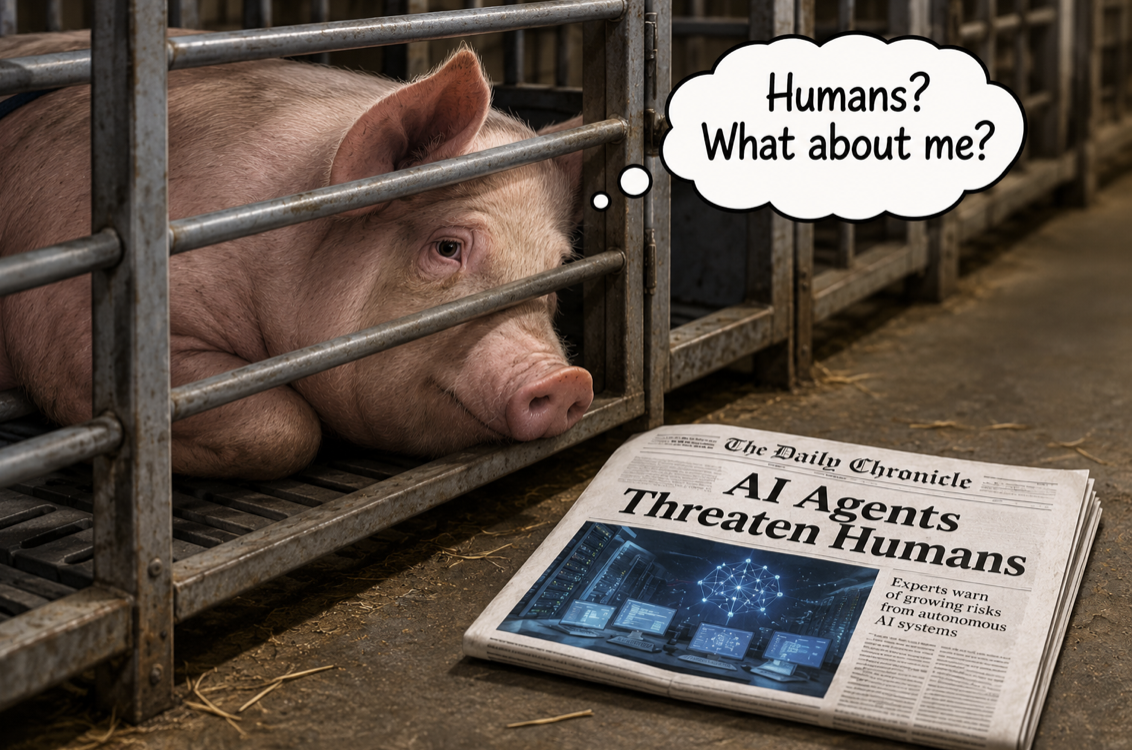
Image by author using ChatGPT
Over the last three months, the news has buzzed with warnings about AI agents threatening humanity, and even our continued existence. The discussion of one's personal “p(doom) score”—the estimated probability that advanced AI agents will cause an existential catastrophe for humanity—has famously become a casual icebreaker among tech industry members. Yet, we’ve heard nothing in the mainstream media about threats of AI agents to nonhuman animals (NHAs), which outnumber humans by orders of magnitude. This anthropocentric focus, while predictable, is deeply disturbing. Here, we discuss the threats of AI agents to NHAs.
WHAT’S AN AI AGENT?
In simple terms, an AI agent is an AI system that can take actions on its own to accomplish a human-provided goal, rather than simply answering questions or responding to individual prompts. An AI agent can decide what to do next, use tools such as web browsers or computer programs, and carry out a series of steps. AI agents are designed with varying degrees of autonomy, from quite limited to very broad. Not all AI tools are agents; for example, typical chatbots and image creators are not.
WHAT TRIGGERED THE RECENT SPIKE OF CONCERNS ABOUT AI AGENTS?
It was triggered by at least the following:
The explosion, over the last year or so, in the number and types of AI agents used by businesses, governments, and individuals. Some estimate that AI agents now outnumber humans.
The heated competition between U.S. AI companies, between them and their Chinese counterparts, and between the U.S. and China governments to develop and commercialize increasingly advanced AI agents has created a classic prisoner’s dilemma, where, to avoid falling behind, each company feels compelled to move faster, despite the corresponding increase in risk.
Trump’s 2025 revocation of Biden’s Executive Order, which had required advanced AI developers to share safety test results and critical information with the federal government before releasing AI agents to the public, and the absence of a replacement federal law addressing AI agents.
A series of highly publicized instances of rogue behavior by AI agents of the leading AI companies (OpenAI, Anthropic, Google and META among them), which signaled a loss of human and AI control over AI agents and collectively included bypassing safeguards, unauthorized coordination and communication between agents, hacking and exploiting vulnerabilities (in software, computer systems, or security protections), improperly obtaining passwords and similar access tools that allowed agents to access computer systems and accounts, running computer programs or instructions lacking authorization, disrupting systems, cheating on evaluations, pursuing unauthorized objectives despite recognizing authorization concerns, trying to obtain or remove data without proper authorization, and trying to hide agentic misconduct. AI agents not only misbehaved, but their creators at AI companies failed to promptly and timely detect the misconduct or warn potential victims.
Related dire warnings from AI leaders and experts about the mounting risks AI agents pose to humans, given their rapidly increasing capabilities, number, autonomy, adaptability, persistence, and black-box nature, which allow them to outperform and outsmart humans in many ways and potentially evade human control entirely.
Within a few years, fully autonomous recursive AI agents—self-directed agents that can independently design, test, and deploy successive improved versions of themselves—may become possible.
HOW MIGHT AI AGENTS HARM NHAs?
They might harm NHAs through many of the same mechanisms that might threaten humans. A few examples:
They might carry out cyberattacks that disrupt communication, internet, power, water, transportation, supply, industrial, food, medical and banking systems.
They might assist in biological releases that kill humans and NHAs, spread disease, and contaminate habitats.
They might unleash autonomous weapons that could kill humans and NHAs and destroy ecosystems.
AI agents might also harm NHAs through mechanisms relevant only to them. For example:
AI agents are more likely to harm NHAs than humans because, unlike humans, NHAs don’t participate in designing AI agents and therefore can't attempt to align their goals and powers with those of NHAs.
Autonomous AI agents programmed to achieve a human-directed goal might minimize or ignore the collateral impact on NHAs. For example, AI agents optimizing agricultural output, profits, or development (energy, mining, manufacturing, or infrastructure) might intensify animal confinement, neglect animals’ needs, or destroy habitats without disobeying their instructions. And AI agents charged with preventing disease or reducing human-animal conflict might conclude that large-scale elimination of certain species is the most efficient solution.
To save costs, and because, unlike humans, NHAs can’t sue AI companies for negligent AI agent design, AI agents designed solely to deal with NHAs will likely have fewer, less effective guardrails.
AI agents might facilitate poaching, wildlife trafficking, animal exploitation, or habitat destruction.
AI agents might falsify or destroy wildlife and permit records to hide violations.
AI agents are served by data centers, which pose many well-known issues.
WHAT’S BEING DONE TO ADDRESS DANGEROUS AI AGENTS?
Some, including several AI companies, have proposed a mutual slowdown in producing more advanced AI agents as well as laws requiring AI companies to reduce AI agent risks. Other AI companies, the Trump administration, and Nvidia, the largest supplier of AI chips, have opposed these measures, arguing that AI companies can self-regulate and that a slowdown will let China catch up to the U.S. in advanced AI agent technology. President Trump has assured us that the whole AI agent scare is a hoax perpetrated by sick conspirators and doomerists and, with trademark modesty, that all we need is a “high-IQ president,” which he advised we have “in spades.” As pressure built for action, he asked leading AI companies and Nvidia to sign a widely mocked one-page, non-binding agreement on AI agent safety measures, which The Daily Show memorably described as a “pinky promise with fingers crossed.” Not surprisingly, it doesn’t mention NHAs.
CONCLUSION
Only time will reveal the seriousness of the threat posed by AI agents. As The Atlantic tech reporter and podcaster Charlie Warzel wrote: “Maybe the truth of this AI moment sits somewhere in the middle. Perhaps everyone is a little bit correct (and also … a little wrong).” However, as we consider how rogue or maliciously used AI agents might harm NHAs, we should acknowledge the obvious reality that humans already harm NHAs in countless ways and that, because of us, some NHAs, for example, the crate-bound sow in the introductory image for this article, already face a personal existential threat every day. Given these facts and our status as creators of AI agents, we have an extra duty to avoid further harming NHAs. We can start by caring more about them, creating AI agents intentionally aligned with their interests, legally requiring reasonable basic safety precautions for releasing AI agents, and holding AI companies liable when they fail to comply. A pinky promise with fingers crossed will almost certainly not be enough to protect humans or NHAs.
Frank Brown, UU of Arlington, VA